How to Write a Website Redesign RFP That Actually Gets Responses
I've reviewed over 500 website RFPs in the past year alone.
Some get flooded with proposals from top agencies. Others sit in inboxes, ignored. The difference isn't budget—it's how the RFP is written.
After analyzing 503 real RFPs worth $37 million in project value, I've identified exactly what separates the RFPs that attract great agencies from those that get passed over. This guide shares the data, the patterns, and real (anonymized) examples so you can write an RFP that gets results.
The Data Behind This Guide
These insights come from analyzing 503 website project RFPs submitted through Folyo between January and December 2025. The projects ranged from $1,500 to $1.5 million, with a median budget of $50,000.
Who's issuing these RFPs:
Nonprofits: 42%
Government agencies: 33%
Education: 7%
Healthcare, associations, and other: 18%
This mix matters because government and nonprofit RFPs tend to be more formal and structured—but the principles of a good RFP apply regardless of your organization type.
1. Include a Budget (73% of RFPs Don't)
Here's the most important insight from the data: only 27% of RFPs include a stated budget. The other 73% either omit it entirely or provide vague ranges.
This is a mistake. Agencies skip RFPs without budgets because:
It wastes everyone's time. A $15,000 budget requires a completely different approach than a $150,000 budget. Without knowing the range, agencies either over-propose (pricing themselves out) or under-propose (leaving scope on the table).
It signals inexperience. Organizations that don't share budgets often haven't done the internal work to understand what websites actually cost. Agencies know this leads to sticker shock later.
It attracts the wrong vendors. The best agencies are busy. They triage opportunities quickly. No budget = next.
What the data shows about realistic budgets:
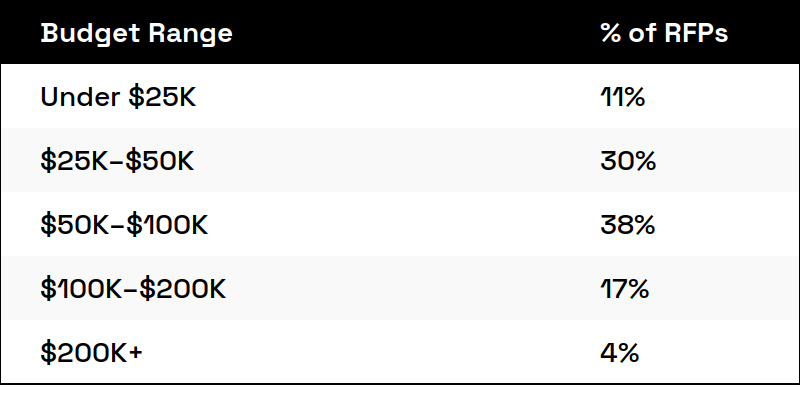
The median website redesign budget is $50,000. If your budget is significantly below this, you may need to adjust scope or expectations.
How to state your budget:
Don't overthink it. A simple range works: "Our budget for this project is $40,000–$60,000, inclusive of design, development, and one year of support."
If you genuinely don't know what's realistic, say so—but commit to a ceiling: "We're targeting under $75,000 and are open to phased approaches if needed."
2. Give Agencies Enough Time to Respond
The median response window across 503 RFPs is 21 days from posting to deadline. But 23% of RFPs give agencies less than two weeks.
Response window breakdown:
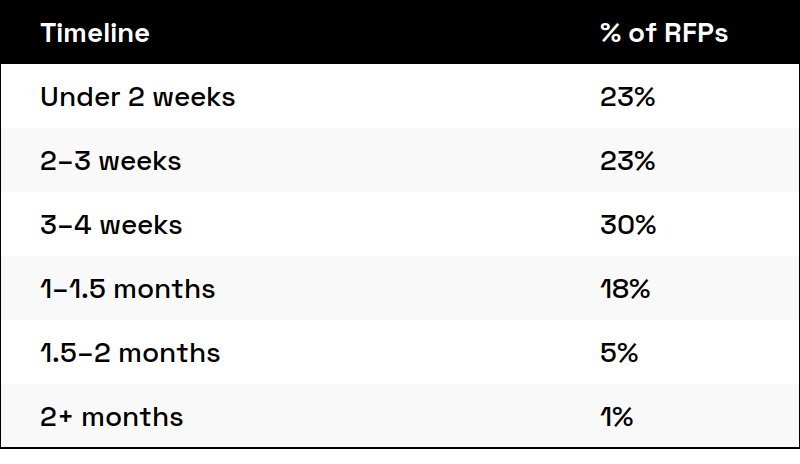
Short timelines (under two weeks) hurt you in several ways:
Quality agencies have existing commitments and can't drop everything
Rushed proposals are superficial—you'll evaluate based on who had availability, not capability
It signals your organization may have unrealistic expectations about the project itself
Recommendation: Allow 3–4 weeks minimum. If your project is complex (migration, integrations, multiple stakeholders), extend to 5–6 weeks. The best responses come from agencies who've had time to review your current site, prepare thoughtful questions, and develop a real strategy.
3. Write a Description That's Actually Useful
The average RFP description is 50 words. That's barely a paragraph.
Some are as short as 10 words: "Transform podcast support site into content hub with enhanced UX."
That tells an agency almost nothing. What's the current platform? What content? What does "enhanced UX" mean to you? What's the timeline?
What to include in your project description:
Current state:
What platform is your current site on?
When was it last redesigned?
What's working? What isn't?
Monthly traffic numbers if you have them
Requirements: Half of all RFPs mention accessibility compliance (WCAG/ADA). Here's what organizations are asking for:
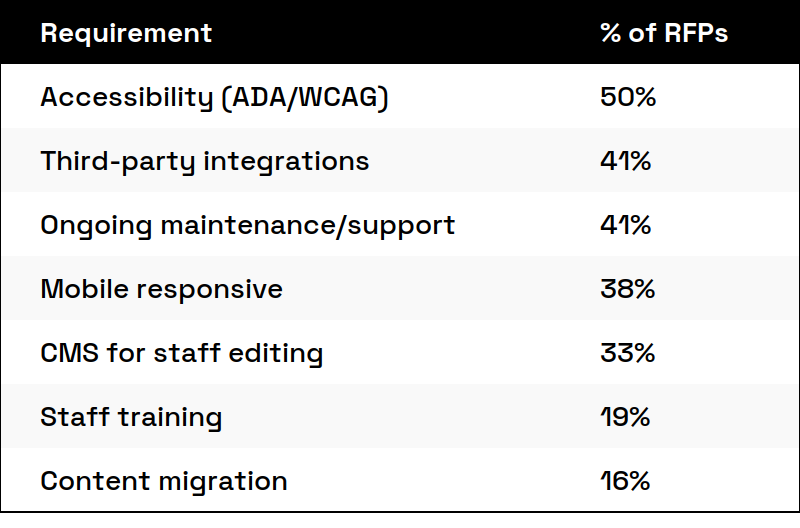
If any of these apply, say so explicitly. "Must meet WCAG 2.1 AA compliance" is more useful than "should be accessible."
Timeline: When do you need to launch? Are there hard deadlines (fiscal year, event, rebrand rollout)?
Stakeholders: Who's involved in decisions? How many rounds of review should agencies expect?
4. Two Examples: What Works vs. What Doesn't
These are based on real RFPs I've reviewed, anonymized and summarized to illustrate the patterns.
❌ A Vague RFP
Organization: Midwest Community College
Budget: $150K (estimated)
Timeline: 13 days to respond
What we could extract from the RFP: Comprehensive website redesign. Approximately 3,000 pages. Migrating from a legacy CMS. Target launch: Summer 2026.
Why agencies skip this:
A 3,000-page migration is a massive undertaking—but the RFP provided almost no detail on content strategy, who handles the migration, or what's changing
No mention of accessibility, integrations, or technical requirements
13 days to respond to a six-figure, 3,000-page project signals the organization may not understand the complexity
Budget was never confirmed—just an estimate based on similar projects
This RFP asks agencies to guess at everything. Most won't bother.
✅ A Strong RFP
Organization: Regional Economic Development Authority
Budget: $60,000 CAD (stated in RFP)
Timeline: 45 days to respond
What made this RFP stand out:
Clearly stated their current site was built in 2008 and outlined specific problems: outdated design, poor navigation, not mobile-friendly, no online services
Listed concrete feature requirements: online forms, event calendar, emergency alerts, social media integration, CMS for staff editing
Defined the full project scope: discovery, design, development, content migration, testing, and staff training
Included a firm budget—no guessing required
Why this works:
An agency can read this RFP and immediately know: (1) if they're qualified, (2) if the budget aligns with scope, and (3) what a winning proposal should address. The honest assessment of the current site's problems shows self-awareness, and the detailed requirements show the organization has done their homework.
5. The RFP Checklist
Before you publish, verify your RFP includes:
Essential (include all):
[ ] Stated budget or realistic range
[ ] Response deadline (3+ weeks from posting)
[ ] Current website URL
[ ] Primary contact name and email
[ ] Project timeline/launch target
[ ] Platform requirements (WordPress, custom, open to recommendations)
[ ] Accessibility requirements (WCAG level)
Important (include if applicable):
[ ] Required integrations (CRM, payment, calendar, etc.)
[ ] Content migration scope (number of pages, who handles content)
[ ] Training requirements
[ ] Ongoing maintenance expectations
[ ] Compliance requirements (government, healthcare, etc.)
[ ] Multilingual needs
Helpful context:
[ ] Why you're redesigning now
[ ] What's working on the current site
[ ] Primary audiences
[ ] Decision-making process/stakeholders
[ ] Evaluation criteria
6. What Agencies Actually Want to Know
After years of matching agencies with projects, I've noticed they consistently ask the same questions about vague RFPs:
"What's the real budget?" Not asking is often a dealbreaker.
"Who approved this project?" Agencies want to know the work is funded and has stakeholder buy-in—not that they're proposing into a vacuum.
"What's the content situation?" Will you provide written content, or is copywriting part of the scope? Do you have brand guidelines?
"Why did you choose us to submit to?" If you're sending to 50 agencies, responses will be generic. If you're targeting 5, say so—it signals you've done your homework.
"What's the decision timeline?" After the RFP closes, when will you decide? Agencies are planning their capacity months ahead.
Answer these questions preemptively and you'll stand out.
Ready to Post Your RFP?
If you're preparing a website redesign RFP, you can submit it directly through the form below.
Here's what happens:
Your project gets in front of a community of 11,000+ top web design agencies—not a general bidding marketplace, just agencies who specialize in website design and development.
Only our paying subscribers get your contact info—only top agencies who are actively looking for new projects and have invested in finding quality work.
I personally review every submission to make sure it's a fit before it goes out
"You did all the legwork. Great job filtering down to just the people who really met the detailed requirements." — Theresa Neil, Guidea
It's free, takes 5 minutes, and typically gets you responses within days—not weeks of posting on freelancer marketplaces and sorting through unqualified pitches.
Quick Reference: RFP Stats at a Glance
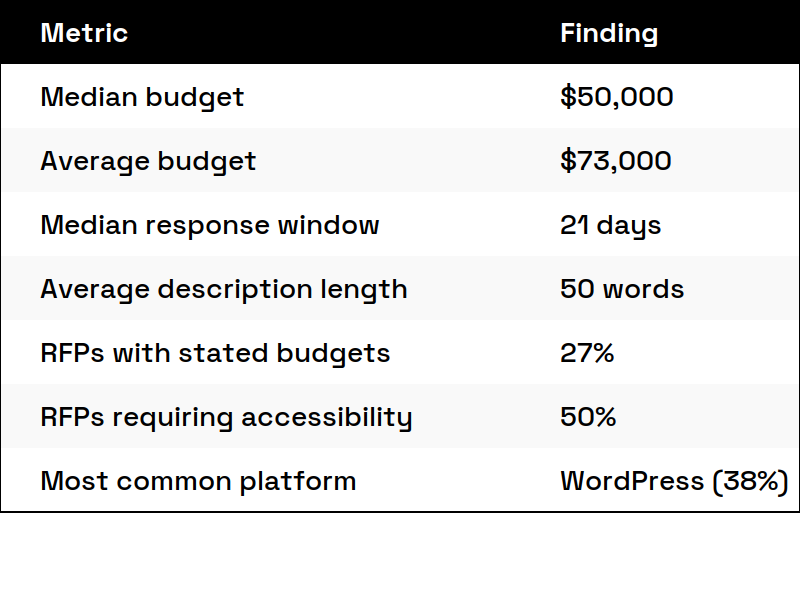
This analysis is based on 503 website RFPs submitted to Folyo between January–December 2025. All examples have been anonymized.
Free Preview
See This Week's Leads
Last year we sent over 500 RFPs, worth over $37M in project work.
Get a free weekly preview of the latest website design and development projects. Sign up below to see what's available.